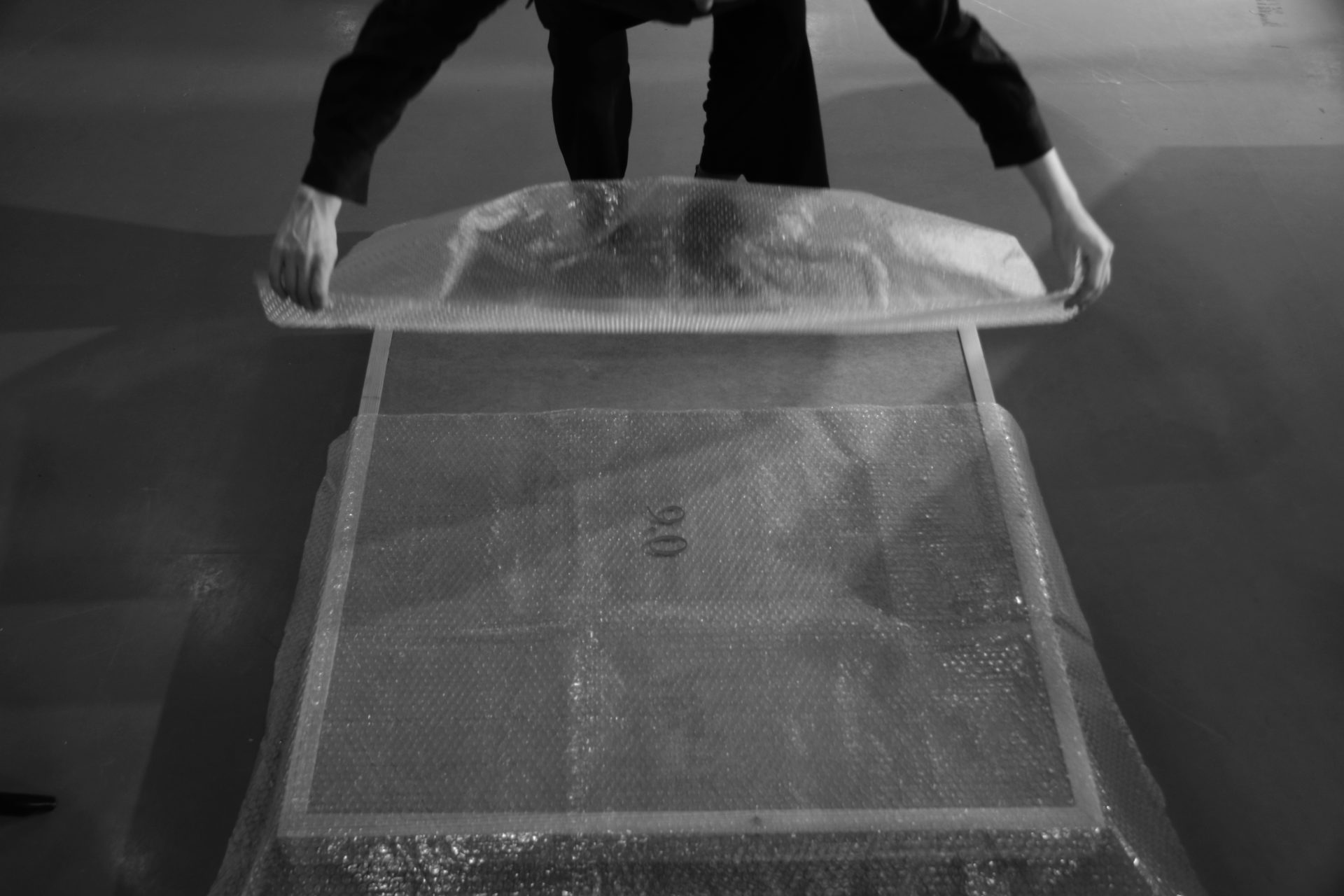
Film screening, performative unboxing & panel talk:
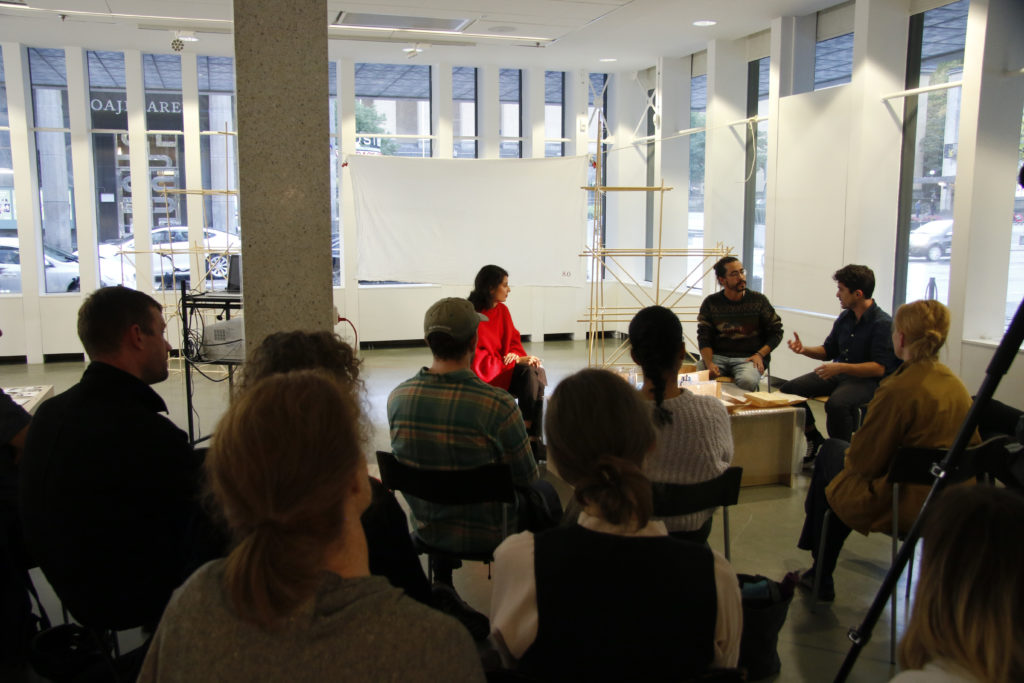
The event took place in the exhibition hall in the City Library in Gothenburg 11th of October 2019. The participants were Sam Carvahlo from ON/OFF and Jesús Flores from Recetas Urbanas. The talk was moderated by Maryam Fanni, doctoral student at HDK.
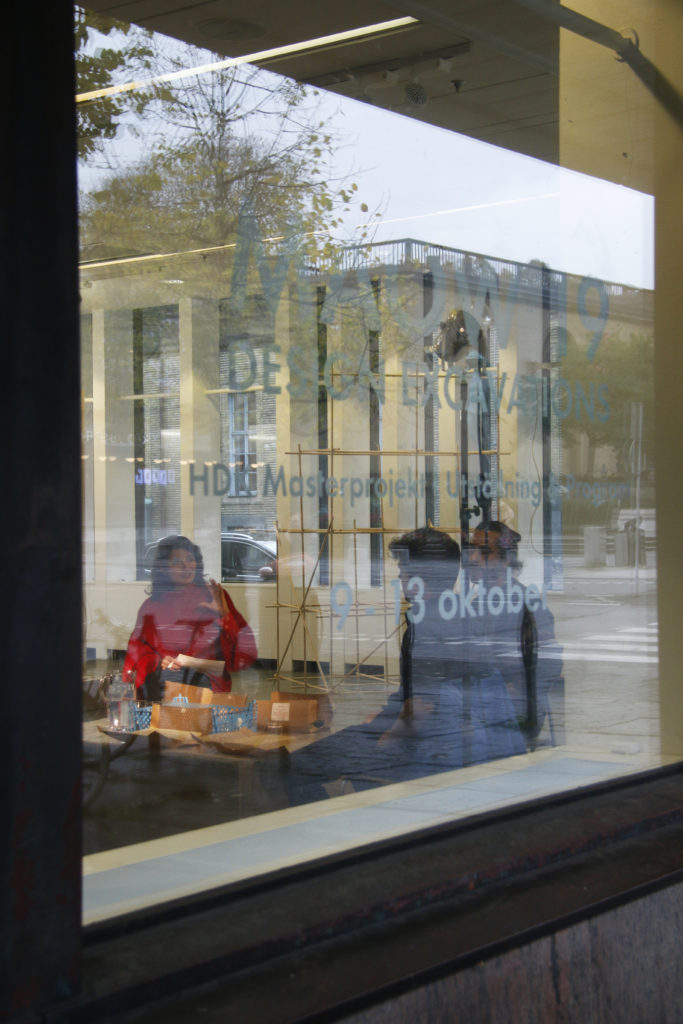
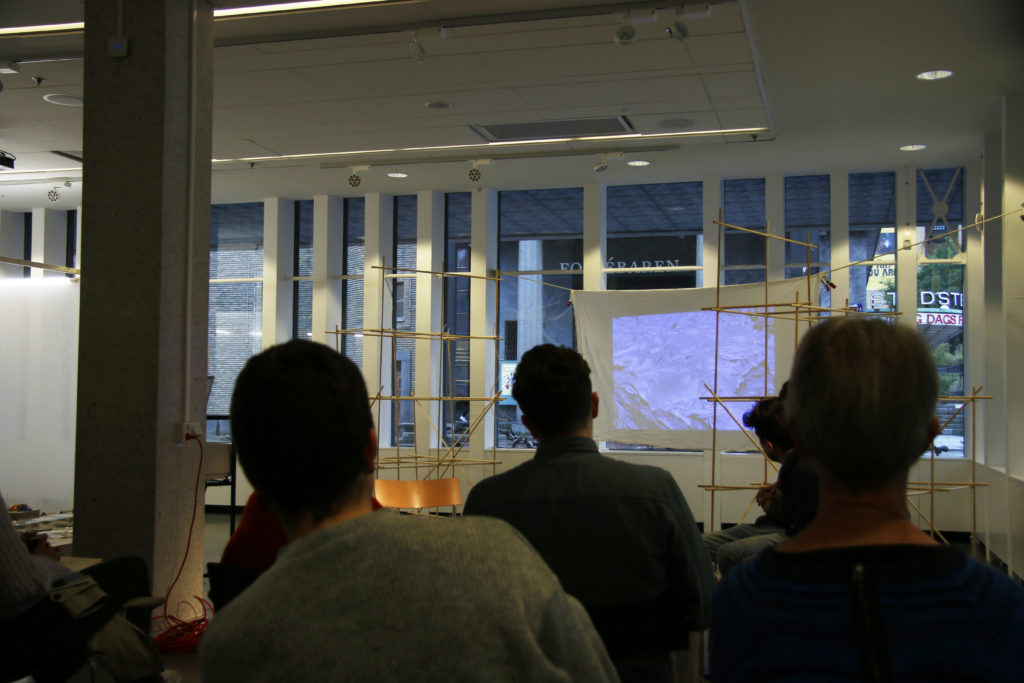
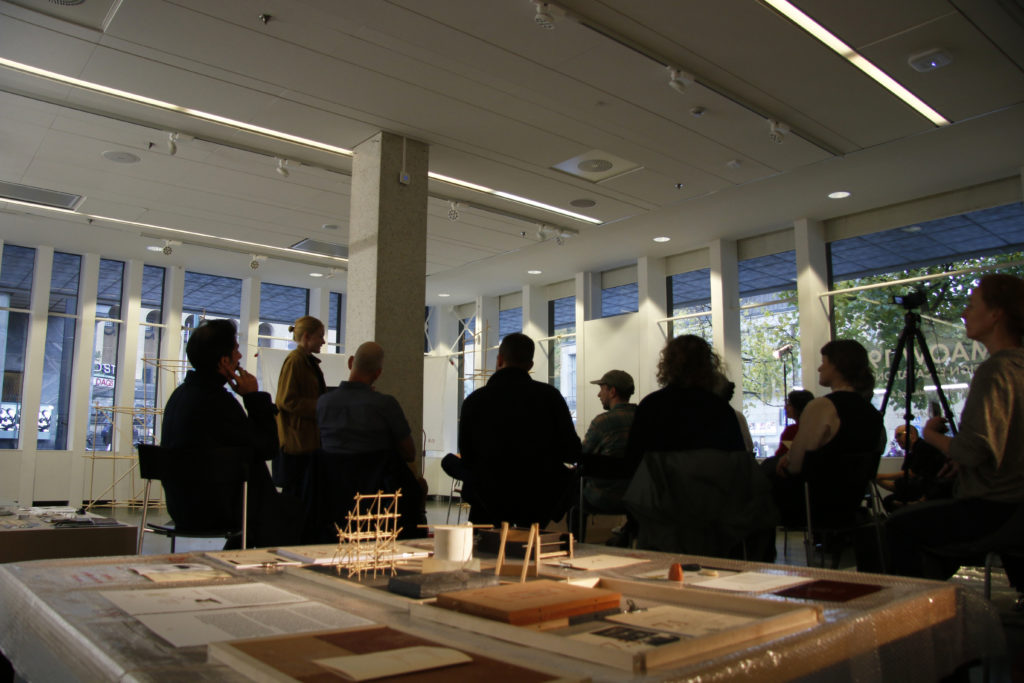
SAM CARVALHO – ON/OFF
Sam Carvalho is a Gothenburg-based architect part of the architecture collective ON/OFF and currently working at Platsbyggnad for Stadsbyggnadskontoret in Gothenburg. Among his experimental, research-based and participatory architectural work there’s a public “smoke tower“ in Hammarkullen. In this project he teamed up with the cooking organisation Hoppet for long-term unemployed women. While previously working for the architecture collective Raumlabour Berlin, Sam was one of the key-architects who together with the city dwellers built the public sauna in Frihamnen 2014. The sauna which has been named “The Church of Sweat” is built on site at scale 1:1 in Frihamnen. The exterior of the sauna is 100 percent made of reused materials as well as a big part of the interior. For example 12000 glass bottles were used when building the changing rooms of the sauna. In the year 2019 the Jubilee Park won the Sienna prize awarded by Sveriges Arkitekter for best landscape architecture.
JESÚS FLORES – Recetas Urbanas
Jesús Flores is part of the Spanish Sevilla based architectural studio Recetas Urbanas. The studio was founded 15 years ago by Santiago Cirugeda, who won the Global Award for Sustainable Architecture in 2015. The projects by Recetas Urbanas, on the edge of the law are adjacent to political activism. By finding loopholes in the law they are often negotiating between the legal and illegal in public space. The built artefacts which many times are made by low-cost or re-usable materials are made for the public by the public. The aim is to teach self building and provide tools and solutions for each and every one to interfere in the process of building. Jesús Flores worked with the outside classroom “Näsan i blöt” in the Jubilee Park in Frihamnen. This space acts as both a weather shelter and a pedagogical space for experimental water play. The architectural work was done during the spring of 2019 together with the public.
MARYAM FANNI – Moderator
Maryam Fanni is a graphic designer based in Stockholm and Gothenburg. Apart from running a studio focused on printed matter, her practice include collective research-oriented long-term projects. She is co-founder and member of the group Mapping the Unjust City, investigating civil rights in relation to ownership in the built environment. She was co-founder and member of rights to the city collective Söderorts Institut För Andra Visioner for six years. Since 2018 she is a PhD student in Design at HDK Academy of Design and Crafts with a project on renewal projects and aesthetic orders in town centers in Stockholm suburbs.
Transcript from the panel talk
Gothenburg Design Festival 2019
MF
Frihamnen has been a much debated project. On one hand a very appreciated place for culture and recreation for many, on the other hand it has raised questions about whom the city is being developed for. It has almost in thought determined the future of Gothenburg in terms of housing and segregation. My interpretation of Unboxing the Monument of Frihamen is that it attempts to elevate the debate to questions of aesthetics, ethics and politics on a level that can allow for critical reflection and that can inform our understanding and actions. So for this conversation by using Frihamnen or Frihamnsporten or Jubileumsparken as a projection surface or background I’m intrigued to have a conversation with you about the potentials and limits of artistic and architectural social interventions and practice. How can we as makers and users of space be in control of what kind of city and future we contribute to create? I’m sure that in your responses you will be able to draw from experiences from many different places, not only Frihamnen in Gothenburg. So I would like to begin by asking you, having seen this interesting film – how do you relate to the concept of monuments or monumentality in your architectural practices? What does this word mean to you and how does the reading of “Frihamnsporten” as a monument resonate with you? What would you say that it is a monument of?
JF
I think the reflection about monumentality is very interesting and in our architectural practice it works in a similar way. We usually build temporary buildings, that last maybe five years, maybe fifteen years. But I think monumentality is not in the place. It’s not in marble or in the bronze. It could be in soap and more temporarily. The monumentality is mostly in the people that work and build to create these spaces. It’s in their minds and not in the place, in the statue or in the material. In our building process I think that’s the important thing – the feelings of the people when they occupy, when they use and build the space. It’s important how the people live there and how they use the space.
MF
So you’re saying that the spatial structure builds human relations that goes beyond temporal aspects of the physical spaces?
JF
Yes, and maybe the architecture does not remain for a long time. But in the mind of the people it remains. It is not a physical monumentality.
SC
Yes, it’s interesting with memory. It’s a bit tricky with the ’monumental’ though, because you can get into semantics. What is a monument? What does it mean? I think, in most people’s minds, city dwellers have a typical idea of it. It’s funny how we sit here in the City Library, having the big male monument in the city – this big man, Posseidon – next to us. I don’t really relate to that and I don’t think our practices relate to that either. But this idea of time and memory that is related to monuments or maybe memorials that celebrates something is quite important in our practice. As Jesùs said many of these projects are temporary and they live a lot out of memory. What stays? What stories are there? So I think that time could be one thing that connects to this kind of monumentality but not the scale. We operate on a very small scale intentionally. And also practically because of time and budget etc.
MF
Does the word monument have negative connotations for you?
SC
I think instinctively yes because I think of these statues that are big and representational and I don’t really relate to these stories.
MF
I think in this case the introduction of the word monumentality in relation to Frihamnen suggests that it is a contested narrative, contested space – or can be. Because monuments are always contested more or less. For me it’s an intriguing suggestion.
SM
I wasn’t aware of how contested Frihamnen was. I’m not from here, I don’t live here. We did the project here and of course we were here a long time, we interacted with a lot of people etc but I’m not aware of the political and social discussions – not the urban philosophical discussions.
MF
I’m not from here either so I haven’t followed the discussions closely but I have noticed that there are discussions about Frihamnen and similar projects as narratives. I would assume that one of the reasons Julia has spent time and effort thinking about Jubileumsparken and Frihamnen is because it has become appreciated and perhaps one can call it a success story. And this is of course something that happens in all cities, that some places or some event become elevated as success stories. But as such it contrasts with the overall landscape or other narratives in the city and the everyday experience of many inhabitants. Just to provide a context apart from the difficult housing situation in the city in general in the neighbour area of Frihamnen Lindholmen in Göteborg – we have recently seen the on-going eviction of a social and cultural centre called Truckstop Alaska for example with 30 000 members and this is happening next to the plan-rising of Karlatornet which will be the countries highest skyscraper and it has by the way already been sold-off to a global and still unknown company. So it’s not built yet but it is sold already. Also in Kvillebeäcken, another neighbour area – we have seen an aggressive gentrification program going on in recent years. Given this context questions are raised in relation to this success story that contains social interventions in public space. So I would like to ask you within this context what would be a progressive way of relating to these kinds of success stories both as an architect and as an inhabitant.
JF
Gentrification is always a shadow in front of us. But in these cases I think the best way is to use the power of the social architecture trying not to gentrify the area and instead recovering the area for the citizens. The idea of these temporal interventions – the sauna and the playground – I think they were perfect for picking up the citizens and involving them in the area as a safetynet for later when the gentrification comes. The citizens then have ways to not lose the space.
SC
Yes, all these projects were prototypes. It was the urban strategy to do them as prototypes. They have limited permits of five years. The sauna is reaching that limit now. It is a success because people go there a lot. That’s the only reason it is a success. And that’s why we did prototypes to see how it works – if the area is adequate, if the technology works – all these parameters. And the sauna is free so the numbers are good. But there could be a scenario where it didn’t work. “We don’t like it.” or “This is not a nice place to make a sauna”. People don’t like the building, it’s too cold or it’s too windy. The sauna works so now it walks over to the second stage of how we extend the permits and improve the sauna. So the success is very determined by the use of it. And the same goes for the urban gardening, the playground – if they don’t work or have problems then maybe we don’t continue them. So the advantage of these small timelines is that you can experiment and test the space and adapt. Not in the other way, that you spend three years planning, you build something for two years and then maybe it doesn’t work. So this is more long-term. Again the time-thing – it is a different timeline.
JF
We have a similar problem in an area in Madrid. It’s called “Canale Real”. It is an ancient grave and this place is an informal settlement which has started to grow in the last 50 years. The administration let it grow up with no control and now they have 9000 people living there in an informal architecture with low conditions of living . Now politicians are entering the area while there is a net of social workers that are contributing to help older people that are there. They are getting a strong social net and they’re not degrading when the political manners are not good. When urban planning and interventions by the municipalities have the risk of gentrification and loose conditions for the people – I think with these temporary interventions, Frihamnen are getting a strong social net. Later when the gentrification comes or when the municipalities come and don’t do their job very well a strong social net will help.
MF
The place allows for a social relations that can make resistance later and that connects back to temporality, what a place produces and what it leaves beyond spatial constructions. What are your thoughts on this, Sam?
SC
I agree, because the dialogue becomes stronger. There’s a critical mass on one side. A dialogue must be established between municipalities, companies, investors, neighbours etc when usually it is not the case. Municipalities arrive and it is the typical top-down. If this work is done before and there is this kind of collective energy being built around the site – the more time the better – there are more chances of dialogue.
MF
I guess that the acute question is – what kind of social relations are established in this place that we are talking about? I think this relates to a quote that I brought with me today by architect Stavro Stavrides who has been working with commons in a greek context. And basically the concept of commons and communing in means practices of inhabiting and governing space that goes beyond the division of private and public and he writes that ”For common space to remain as common it needs to be a mechanism that continuously processes the contribution of those who are invited to use the common space. In other words common space cannot be fixed in form of a product, no matter how collectively it was produced, because it keeps on producing those who produced it.” So, he is talking about a mechanism that continuously is producing the users and since both of you are experienced in thinking about how space structure social relations I wanted to ask if such mechanism that Stavidres talks about is something you believe can be provoked through spatial articulation and I guess I’m also curious to think about what social bounds Frihamnen can leave behind or produce that continue producing us as users.
SC
That’s a tough one – there’s a lot to entangle.
MF
I guess if I may elaborate on why I’m asking this question – it’s also because most commons that come to mind for me are for example social centres in occupied or abandoned spaces…
SC
Like Truckstop Alaska…
MF
Yes, whereas a lot of public social projects are short-sided and failed to continue. And for example the word “projekttrötthet” – project tiredness was introduced to the Swedish academy glossary in 2017. So I just put out this dichotomy and see if it can provoke a discussion here. That’s also why I’m curious to what new initiatives can produce or suggest.
JF
When we work with a project the process is always more important than the result. We have the building finished, the process is over and the energy of the people/citizens in many times goes down. Therefore what’s more interesting is the process. Many times we use the key of not closing the project for letting the citizen finish it when they want. In Galicia in the North of Spain last summer we made an intervention in a museum. There were people working in an occupied jail. They were trying to reactivate the space and create a social space for the citizens. They needed two ramps and they hired us for building them. We went to the jail and knew all the work of them and we made a beautiful journey building a ramp for them. But the second ramp was not our purpose. We provided them with material, how to do it and they finished it. They were free to finish it when they wanted and the process was left open. I think it is very interesting what Stavrides says how to continue the production of public space – the energy – and one key could be to not close the process. It is open and the people that use the space need to contribute.
SC
…and come back and take care of it. And you create care-takers which is usually a good sign of this process. When caretakers come up and say “I’m part, I’ll stay and I will come back.”.
JF
…and the self management of the space.
SC
This is the base and this connects to the Stavrides because as Jesús said it is not the commons it’s the communing. It’s the action of producing commons that’s most important – that’s the base. It’s self organization, meeting, dinners, talk, parties – never ending resources of formats for this. That’s really the fundamental work. This idea of keeping it open is interesting. To connect it to Truckstop Alaska, maybe it is a good example – I could tell that it is this kind of process, this kind of association. It is probably very horizontal in the way it is created and a collective decision-making. These kinds of association corporations are usually very strong in its process. But how to continue this and not having the effects of people moving out or the energy coming down is very tricky. The solution is very complex.
MF
If you draw from your experience have you seen that happen when you are in a project and create a new space, a social project – and then you see a continuation of it that is self-managed?
Audience
I was thinking about this self-management that you were talking about and how you keep it up. How do we make sure that it keeps clean or for example if something breaks – who’s in charge? I was part of the building process as a volunteer and when it’s built by citizens and it’s for citizens – I wonder if the citizens are the owners? And who is responsible for example if a pipe in the water area is broken – who is in charge? This is a more practical question.
SC
With the sauna there are some of these cases because we did a lot of workshops and open calls. There was a big group building with us. Some people returned and were involved in other workshops. But I know an example of one man who goes almost every day to the sauna. Whenever I’m there he is always there. And he is the one taking care of putting the water on the stove and he cleans the space and he does it out of his own interest. So he became a self-entitled caretaker. I think it happens because the right energy is there. The place is run by young people – kids. So it’s easier to step in. The project itself looks self managed. It’s quite soft to use the metaphor from here and it’s public. People know the municipality owns it but there is a feeling of a space to participate.
JF
It sometimes works and sometimes not and we need to reflect on why it sometimes does and sometimes not. But I think that self-management is very powerful and the administration needs to have support for it. I think it works better when it’s not controlled – the people that are using the space are cleaning and taking care of the space. As you say, if a pipe is broken I’m not an engineer to solve it but it is so much better if we can solve problems ourselves. The name of our studio is Recetas Urbanas which means urban recipes in English – and is meant for these purposes. Give tools to the citizens and do not professionalise it. If you need help you should give the task away – if you need an architect because you don’t know how to do it – but if you have the recipe you may do it yourself.
SC
The thing with Recetas is that they know very well how to act with the law and at the edge of the law in this kind of way…
JF
When it is necessary.
SC
…on the paper a citizen can’t go and fix a pipe because he is liable for that pipe. But then there are ways of – which is also another theme that practices like this work on – how to navigate this world of permits and regulations etc.
MF
I think in relation to success stories and narratives, that’s also an interesting strategy – to also address the limits and restrictions. Do you have more questions?
Audience
I’m curious about how Julia will continue to explore this topic and if this talk has informed your exploration.
JA
First I’m very happy that you have taken on this task to unpack what I have put on the table today for this conversation. I think there’s many interesting conversations going on here and it would be nice to deepen this talk, meet again so that it becomes a continuous work of reflection. What you say about caretakers and how to create a feeling of ownership in public space is for example very interesting to continue talking about.
Audience
And you will do it? It sounds as if you will do it in some way?
JA
In best case the project will continue as a continuous unboxing.
SC
I’m also curious to continue the dialogue. Because as Jesús said this methodology or this knowledge is experimental and testing. How to know what is the right way, discussing certain problems or contexts. I’m very interested in discussing this.
MF
And also in your new profession roll your in continuous not only dialogue but really involved in the development of Frihamnen and the methods of planning.
SC
Because I’ve only been there for half a year I’m still observing. I’m still looking around as “What is a city planning office?”
Audience
Now when you’re working on the city planning office, can you see there’s a process of adjustment in the initial structural plan?
SC
I’m not working directly on Frihamnen anymore. I’m working in Hammarkullen actually but I hear about the on-going processes and that the detail plan is shifting a lot because of new things coming up, feasibility, how much you can build. Because it’s on piers, it’s a harbour, there’s water levels rising, there’s structural problems. The only thing I know is that these plans are constantly changing. But I do know that the permanent park will start to be built this spring. So the prototype phase has ended – the six, seven projects – and now it’s handed over to park and nature and they will now build the Jubilee Park, which is the long term-park. But Recetas Urbanas project will stay, the sauna will stay and they’re still discussing about the other ones. So this is interesting that these prototypes came first and now the long-term-park has to kind of adapt around it and is informed by its process.
Audience:
I was more interested in the kind of power relationship in-between the prototype and the planning office and the higher instances in the city..
SC
You mean like developers?
Audience
The main issue they had with this plan was that the building of housing areas were too low – not necessarily the infrastructure foundations on the ground – that related to the prototype and the aim that you had with the prototypes. I don’t mean to be critical about it but now you´re on the other side. Going from prototype – a more activist perspective maybe – and now working at the institution.
SC
I’m not in those meeting rooms I can guarantee you. I’m at platsbyggnad. The city is trying to give some space for these kinds of approaches. So I’m working in Hammarkullen but still with space, workshops and not on those meetings so I don’t know what’s going on – if it’s developers, foundations. What I hear is probably what you hear.
MF
I think we are out of time so I would like to thank Sam, Jesús and also Julia for arranging this and I also hope for a continuation somehow. You’ll have to keep us updated on that.